
Twin sleep at 12–18 months is loud, unpredictable, and full of new chaos. If you’re parenting twins in this stage, you already know how quickly peace can turn into pandemonium. One day, your twins nap beautifully, go down easily, and sleep through the night. The next day? Everything falls apart. Suddenly, bedtime becomes a battle, naps get messy, and your once‑reliable routine feels like it’s been tossed out the window. It’s the kind of shift that makes you stare at the monitor, wondering what happened to the peaceful rhythm you worked so hard to build.
This age brings huge developmental leaps, big emotions, new independence, and shifting sleep needs — all at the same time. And when you multiply that by two, the intensity skyrockets. You’re not just managing one toddler’s sleep transition; you’re managing two toddlers who may be on completely different timelines, with completely different temperaments, and completely different ideas about when they should sleep.
If your twins are suddenly refusing naps, melting down before bedtime, or waking overnight again, you’re not imagining it. Twin sleep at 12–18 months is one of the most dramatic stages of toddlerhood. It’s normal, it’s messy, and it’s survivable — once you understand what’s happening beneath the surface.
Let’s break down the nap transitions, regressions, bedtime battles, and new chaos of this stage, and how to navigate it without losing your mind.
Why Sleep Gets Messy at 12–18 Months
This age is a perfect storm of developmental changes. Your twins are learning new skills daily — walking, climbing, talking, asserting independence, testing boundaries, and exploring everything. Their brains are exploding with growth, and that growth directly impacts sleep.
Here’s what’s happening behind the scenes:
- They’re becoming more aware of the world. Sleep suddenly feels boring compared to exploring, climbing, or following you around the house.
- They’re developing separation anxiety. Being away from you — even for a nap — can feel overwhelming.
- They’re testing independence. Saying “no” to sleep is one of the easiest ways to assert control.
- They’re shifting nap needs. The two‑nap schedule starts to wobble, and the one‑nap transition begins.
- They’re experiencing emotional leaps. Tantrums, clinginess, and big feelings show up everywhere, including bedtime.
- They’re teething. Molars often erupt during this stage, and molars are brutal.
- They’re becoming more sensitive to routine changes. Even small disruptions can throw off sleep.
All of this is normal — but when you’re parenting twins, the chaos doubles. One twin may be ready for one nap while the other still desperately needs two. One may fight bedtime while the other collapses instantly. One may wake early while the other sleeps in. And you’re stuck trying to create a routine that works for both.
If you’ve already lived through the newborn and early‑infant sleep stages, you know how quickly things can shift. The patterns you saw in twin sleep in the first 6 months were just the beginning — this stage is where toddler independence collides with sleep needs, and everything gets louder.
The Two‑Nap to One‑Nap Transition
This is the biggest sleep shift of the 12–18 month stage, and it’s often the messiest. Most toddlers transition to one nap somewhere between 13 and 18 months — but twins rarely transition at the exact same time.
Signs your twins are ready to drop the morning nap:
- They consistently refuse the morning nap.
- They play in their crib instead of sleeping.
- They take a very late morning nap, which pushes the afternoon nap too late.
- They take a long morning nap but refuse the afternoon nap.
- Bedtime becomes a battle because they’re not tired enough.
- They wake earlier than usual.
Signs they’re NOT ready:
- They melt down before lunch.
- They fall asleep instantly when you put them down.
- They’re overtired by mid‑afternoon.
- They wake multiple times overnight.
- Their behavior becomes more chaotic, clingy, or emotional.
The tricky part? One twin may show readiness while the other doesn’t. And you can’t run two separate nap schedules forever — not unless you want to lose your sanity.
Here’s what works for most twin families:
- Keep the morning nap short. Cap it at 20–30 minutes to preserve the afternoon nap.
- Shift the morning nap later. Move it from 9:30 to 10:00, then 10:30, then 11:00.
- Watch behavior more than the clock. If they’re melting down, they’re not ready.
- Use early bedtimes during the transition. Overtired toddlers sleep worse, not better.
Expect inconsistency. Some days they’ll take two naps, some days one, some days neither. That’s normal.
If you’ve already navigated days where naps completely fall apart, you know how quickly the whole day can unravel. Your experience with how to reset your day when twins won’t nap becomes incredibly useful here — because nap refusal is practically guaranteed during this transition.
The transition can take weeks — sometimes months — and that’s okay. You’re not behind. You’re not failing. You’re simply navigating the reality of twin development.
The Bedtime Battles of 12–18 Months
Bedtime becomes harder at this age for one simple reason: toddlers suddenly realize they have opinions.
They don’t want to stop playing. They don’t want to be separated from you. They don’t want to be confined to a crib. They don’t want to follow a routine. They don’t want to sleep when their twin is still awake.
Bedtime battles often look like:
- crying when you leave the room
- standing up in the crib
- throwing loveys or pacifiers
- screaming for one more book
- clinging to you during the routine
- refusing to lie down
- laughing hysterically instead of calming down
- copying each other’s chaos
This is all normal — and temporary.
What helps:
- Keep the bedtime routine predictable. Toddlers thrive on repetition.
- Use calming cues. Dim lights, quiet voices, slow movements.
- Offer choices. “Blue pajamas or green pajamas?” “This book or that book?”
- Stay consistent. Toddlers test boundaries to confirm they exist.
- Separate the twins if needed. Some twins hype each other up at bedtime.
- Use a short wind‑down period. Ten minutes of quiet play before bedtime helps.
- Avoid overtiredness. Overtired toddlers fight sleep harder.
If your bedtime routine has already been working well, this is a good moment to revisit the structure you built in twin toddler routines that actually work. Toddlers crave predictability, especially during sleep regressions.
Night Wakings: Why They Return
Just when you think you’ve survived the newborn stage, night wakings return. This is one of the most frustrating parts of 12–18 month sleep, especially for twin parents who thought they were finally past the worst of it.
Night wakings at this age are usually caused by:
- overtiredness from nap transitions
- molars (the worst teeth of all)
- separation anxiety
- new skills (walking, climbing, talking)
- developmental leaps
- inconsistent nap schedules
- too much stimulation before bed
- hunger from increased activity
What helps:
Earlier bedtimes during nap transitions. Comfort during teething (cold washcloths, teething rings). Reassurance during separation anxiety. Consistent routines. Predictable nap windows. Calm, quiet pre‑bedtime activities. Avoiding screen time before bed.
Night wakings are normal — but they don’t last forever. Once the nap transition settles, sleep usually stabilizes again.
When Twins Disrupt Each Other’s Sleep
This is the part that makes twin sleep uniquely challenging. One twin wakes, cries, or plays — and instantly wakes the other. One twin refuses nap time — and the other follows. One twin stands up in the crib — and the other copies.
Twin sleep disruption is real, and it’s exhausting.
What helps:
- Staggered bedtimes. Put the calmer twin down first.
- White noise. It masks crying, babbling, and movement.
- Crib separation. Move cribs farther apart or angle them differently.
- Temporary room separation. Use this during regressions or nap transitions.
- Individual soothing. Comfort one twin without waking the other.
- Predictable routines. Twins thrive on structure.
- Reassurance. Both twins need to feel secure, even if they express it differently.
You’re not failing if your twins disrupt each other’s sleep. You’re parenting two toddlers with developing brains, big emotions, and zero impulse control. This is normal.
Sample Twin Sleep Schedule (12–18 Months)
Here’s a realistic schedule for twins transitioning from two naps to one:
Two‑nap days:
- 7:00 wake
- 10:00–10:45 nap
- 2:30–3:30 nap
- 7:00 bedtime
One‑nap days:
- 7:00 wake
- 11:30–1:30 nap
- 6:30 bedtime
Transition days:
- 7:00 wake
- 10:30–11:00 micro‑nap
- 2:00–3:00 nap
- 6:45 bedtime
This is not a perfect schedule — because perfect schedules don’t exist. It’s a framework you can adjust based on your twins’ behavior, temperament, and needs.
How to Stay Sane During This Stage
Twin sleep at 12–18 months is intense. You’re managing two toddlers, two sets of needs, two personalities, and two sleep transitions — all while trying to stay calm, patient, and functional.
Here’s what helps you survive:
- Lower your expectations. This stage is messy for everyone.
- Stay flexible. Some days will be beautiful, others will be chaos.
- Take breaks. Step out of the room when you need to breathe.
- Tag‑team with your partner. Divide bedtime or nap routines.
- Use early bedtimes. They save everything.
- Remember, this is temporary. The chaos doesn’t last forever.
You’re not failing because your twins fight sleep. You’re not failing because naps are inconsistent. You’re not failing because bedtime feels like a circus. You’re succeeding because you’re showing up, adjusting, and doing your best in a stage that challenges every parent — especially twin parents.
The Bottom Line
Twin sleep at 12–18 months is chaotic, unpredictable, emotional, and absolutely normal. Nap transitions take time. Bedtime battles come and go. Night wakings return. Routines wobble. And your twins will not always be on the same sleep timeline — no matter how hard you try.
But with consistency, flexibility, and realistic expectations, this stage becomes manageable. Your twins will settle. The naps will stabilize. Bedtime will get easier. And you’ll come out of this stage stronger, more confident, and more attuned to your twins’ needs.
You’re not alone in this chaos. You’re doing an incredible job.
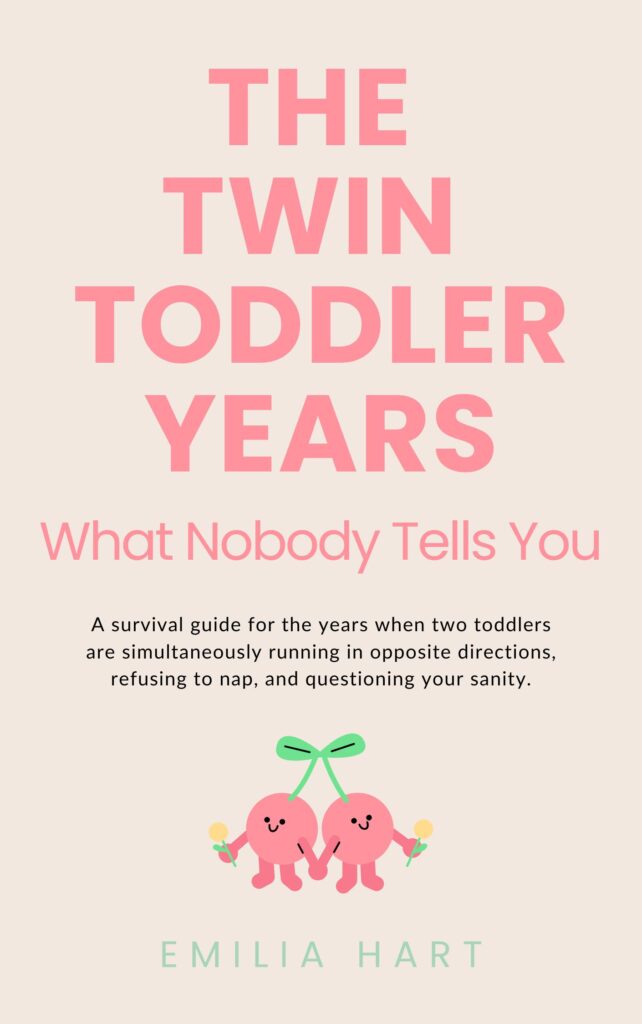
The Twin Toddler Years
If you’re deep in the toddler stage — the chaos, the clinginess, the meltdowns, the breakthroughs, the moments that make you laugh and cry at the same time — you deserve a guide that actually understands what this season feels like. That’s why I wrote The Twin Toddler Years.
This isn’t a textbook. It’s a survival guide for the days when everything feels like too much, when both toddlers need you at once, when the guilt hits hard, and when you’re trying to stay grounded in the middle of constant noise and constant love. It’s honest, practical, and written for real twin parents living real twin life.
If you’re craving clarity, reassurance, and a voice that says “you’re not failing — this stage is just intense,” this book will meet you exactly where you are. It will help you feel less alone, more supported, and more confident in what actually matters during these wild, beautiful toddler years.