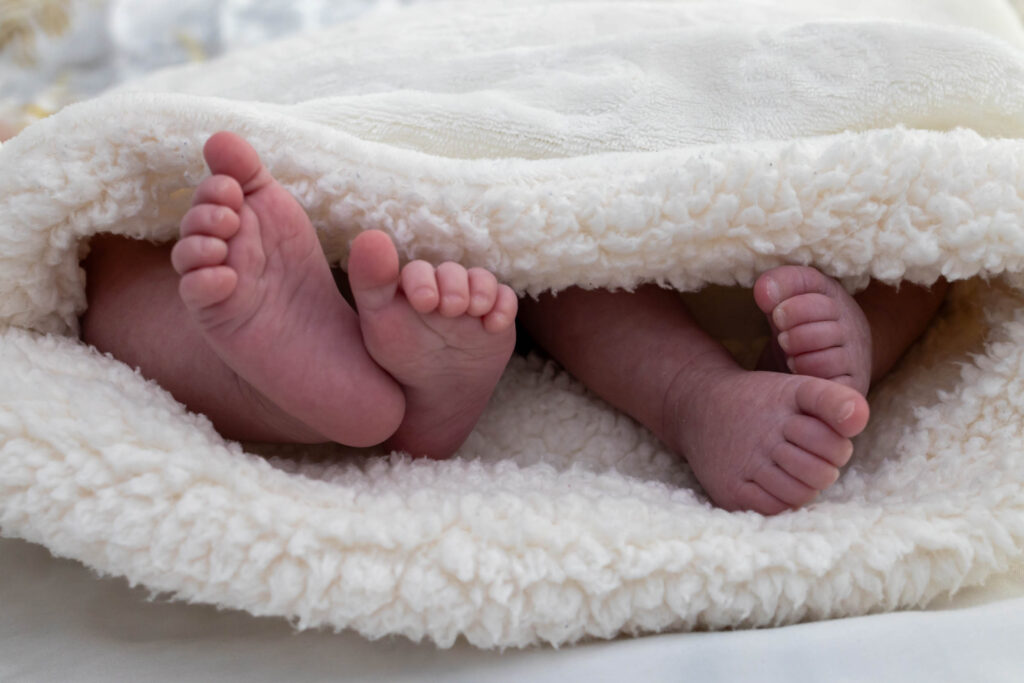

Because “sleep when the baby sleeps” clearly wasn’t invented by a twin parent.
Welcome to the Twin Sleep Universe
If you’ve found yourself here, you’re probably deep in the trenches of twin sleep in the first 6 months — the season where nights blur into mornings and you’re never entirely sure who woke up first or why. Maybe you’re bouncing one baby while the other grumbles in the bassinet, or scrolling at 3 a.m. (AGAIN) trying to figure out if anyone else’s twins treat sleep like an optional hobby. Maybe you’re running on cold coffee and sheer determination, wondering how two tiny humans can produce this much noise, chaos, and unpredictability.
Twin sleep in the early months is its own universe — one with rules that shift daily, patterns that appear and disappear without warning, and moments where you genuinely question whether sleep is a myth invented by people with singleton babies. Nothing about this phase is straightforward. Twin sleep is unpredictable, messy, and often feels like a puzzle with pieces that keep changing shape. But here’s the part most parents don’t realize until they’re in it: even in the chaos, there are patterns. There are strategies. And there are ways to make this season feel less like survival mode and more like something you can actually navigate.
That’s what this guide is here for — not to give you a perfect schedule or a magical fix (because twins laugh in the face of those), but to give you realistic tools, grounded expectations, and the kind of reassurance that actually helps at 2 a.m. when both babies are wide awake for reasons unknown.
The truth is, nothing about twin sleep is linear. One day you’ll feel like you’ve cracked the code, and the next day both babies will unionize and protest sleep entirely. That’s normal. That’s twins. And that’s why you’re here — not for perfection, but for survival, sanity, and a little bit of hope.
Let’s walk through what actually matters in these early months.
Your Twins Are Individuals — Not a Matching Set
Some sleep like angels. Some sleep like squirrels on espresso. Some do both… on the same night.
One of the biggest surprises for new twin parents is realizing that “twins” does not mean “identical sleep habits.” Even identical twins can have wildly different sleep patterns, temperaments, and needs.
One baby might drift off peacefully with white noise and a gentle rock. The other might require a full Broadway production, a warm bottle, and a prayer.
The biggest mindset shift?
Don’t expect them to have identical sleep habits. It’s not you — it’s just them.
Trying to force them into the same rhythm too early can make you feel like you’re failing when you’re not. You’re simply parenting two different humans who happened to arrive on the same day.
For more on this, check out: Is It Normal for One Twin to Sleep Worse Than the Other?
“Sleep When the Baby Sleeps” Doesn’t Always Work
Because when Baby A sleeps… Baby B is doing a TED Talk at 2 a.m.
The classic advice — “sleep when the baby sleeps” — is adorable in theory and absolutely useless for twin parents. If you followed it literally, you’d sleep in 12‑minute increments and develop the circadian rhythm of a confused squarrel.
Instead, aim for this:
Sleep when both babies have even a partial overlap. Even 45 minutes of synced sleep is gold.
This might mean:
- letting dishes sit
- ignoring laundry
- eating crackers for dinner
- turning your phone on Do Not Disturb
- or… asking your partner to take one baby while you nap with the other (take turns if you’re both caring for your babies)
You’re not being lazy — you’re being strategic. Twin sleep is a team sport, and rest is a survival tactic.
Wake Windows Matter… But They Aren’t Magic
You’ll hear a lot about wake windows, and yes — they’re helpful.
But let’s be honest: They are not a magic spell.
Wake windows help guide you, not guarantee long naps. Think of them as:
A rough roadmap, not a “your baby will definitely sleep 90 minutes now” rule.
In the first six months, wake windows shift constantly:
- Newborns: 45–60 minutes
- 2–3 months: 60–90 minutes
- 4–6 months: 90–120 minutes
But babies don’t read charts. Some days they’ll nap beautifully. Other days they’ll fight sleep like it’s their sworn enemy.
Night wakings are common — see Twin Night Wakings for more on that rollercoaster.
Should Twins Sleep Together or Separately?
Here’s the truth no one tells you:
It depends on your babies AND your sanity.
Some twins sleep better together because the presence of their sibling is soothing. Others wake each other constantly and need separate spaces to settle.
You might try:
- same crib at first
- separate cribs in the same room
- separate rooms temporarily
- starting separate and transitioning together later
There is no wrong choice — just the choice that keeps you functioning.
If separating them helps everyone sleep, do it. If keeping them together feels easier, do that. If you switch back and forth depending on the week, welcome to twin parenting. We tried all of the different combinations until we found what worked best for us.
The Witching Hour Is Real
Somewhere between 5 p.m.–10 p.m., the universe hits a switch and both babies decide:
“Let’s scream. At the same time. For no reason.”
This is normal. It doesn’t mean anything is wrong. It doesn’t mean you’re doing anything wrong.
It’s simply overstimulation, exhaustion, and newborn chaos colliding.
What helps:
- Wearing one baby in a carrier
- Low lights, low stimulation
- Taking turns with your partner
- A warm bath
- A walk outside
- Accepting that this phase does end
The witching hour is temporary — even if it feels eternal when you’re in it.
Naps Are a Messy Situation… and That’s Normal
Newborn naps are all over the place.
Some patterns you may recognize:
- The 12‑minute nap
- The “falls asleep in your arms but wakes up the moment you exhale” nap
- The “we did everything right and it still didn’t work” nap
- The “one twin naps beautifully while the other refuses” nap
You’re not doing anything wrong. You’re building habits — not perfection.
The consistency comes later, usually around 5–6 months, when sleep cycles mature and babies can stay awake longer between naps.
Until then, naps are practice. For them and for you.
Night Wakings Are Not a Sign of Failure
Babies wake at night — a lot. That’s biology, not bad parenting.
Things that actually help:
- Tag‑teaming feeds
- Prepping bottles in advance if you’re formula feeding
- Taking shifts so both parents get a block of sleep
- White noise (a big helper!)
- Dark room, simple routine
- Keeping nights boring and predictable
Small systems = big sanity.
Early schedules can make sleep more predictable — see A Realistic Daily Schedule for Newborn Twins.
Sleep Training: Honest Reality Check
Let’s keep this super real:
Sleep training works for some babies. It does not work for others. And with twins, it can be twice as confusing. For me, it worked for one baby and not the other. My son learned to sleep through the night after 3 nights of training at about 4 months, but my daughter was a whole other story. Sleep training just made her really stressed so we had to back off with that for her.
Your experience matters:
- One of your babies responded well.
- The other… not so much.
- And forcing it when it felt too stressful? Not worth it.
The best approach?
- Follow your babies’ temperaments
- Stop if it becomes emotionally overwhelming
- Do what keeps your household functioning
This is survival mode — not a parenting contest.
There is no gold medal for “least night wakings.” There is only what works for your family.
It Gets Easier — And Then Beautiful
The biggest thing twin moms say?
Month 6 is a turning point.
It doesn’t happen overnight, and it doesn’t happen in a neat, tidy way — but it does happen. Slowly, your twins start interacting with each other. Sleep stretches get longer. Their nervous systems mature. Their wake windows stabilize. You get tiny pockets of predictability that feel like oxygen after months of chaos. You start to recognize their rhythms, their cues, their quirks. You start to feel like you again.
The fog lifts. The chaos softens. And you realize you’ve done something extraordinary — you’ve navigated one of the most intense seasons of parenting that exists, and you’ve done it with two babies at once. You’ve survived nights that felt impossible, days that felt endless, and moments where you weren’t sure you could keep going… and you did.
You’re doing an incredible job — even on the days that feel impossible. Even on the days where naps are a disaster, nights are unpredictable, and you’re running on crumbs of sleep. Even when you feel like you’re failing, you’re not. You’re parenting twins — and that alone is a level of strength most people will never understand.
It gets better. Hang in there.
You don’t need a perfect schedule — you need a flexible rhythm that works for twins. And you’re already building it, one messy, beautiful day at a time.
The Calm Twin Life System helps you create calmer days without forcing your children into a rigid routine.