If you’ve ever watched your twins fight over something as small as a spoon, a sock, or the exact same piece of air, you know how quickly peace can turn into chaos. One minute they’re giggling together, the next they’re screaming like rival gladiators in the living room. You’re standing there, holding two sippy cups, wondering how you became the referee in a toddler boxing match — and why twins fight over everything with such dramatic intensity.
Twin fights are intense. They’re loud. They’re emotional. And they’re completely normal.
But when it feels like they fight over everything — toys, snacks, attention, who gets buckled first, who gets the blue cup, who gets the other blue cup — it can leave you wondering if you’re doing something wrong. You’re not. You’re just parenting two little people who share everything except their moods.
And the truth is, the fighting isn’t random. It’s not because they’re “bad,” or because you’re not doing enough, or because you didn’t intervene fast enough. It’s because twins live in a world where everything is shared — space, routines, parents, toys, milestones, even your facial expressions. They’re constantly navigating closeness, competition, and connection all at once. Their fights are simply the messy, loud, toddler version of learning boundaries, identity, and emotional regulation.
Let’s talk about why twins fight so much, what’s actually happening beneath the surface, and how to handle it without losing your mind (or your voice).
Why Twins Fight Over Everything
Twins fight for the same reason all siblings fight — but amplified. They share space, toys, routines, and parents. They share milestones. They share attention. They share everything. And that closeness, while beautiful, also creates friction.
At 2–4 years old, twins are still learning emotional regulation. They don’t yet have the words to say, “I’m frustrated because you took my toy,” or “I feel jealous because Mom picked you up first.” So instead, they yell, push, grab, or cry. It’s not malice — it’s communication.
Twins also live in constant comparison. Even if you never compare them, they compare themselves. They notice who gets praised first, who runs faster, who talks more, and who gets the bigger cookie. They’re wired to measure themselves against each other because they’ve shared every stage of life side by side.
And because they’re the same age, there’s no natural hierarchy. There’s no older sibling to defer to or younger sibling to protect. They’re equals — which means every disagreement feels like a power struggle.
The Hidden Layer: Competition for You
Here’s the part most twin parents don’t talk about out loud: sometimes the fighting isn’t about the toy at all. It’s about you.
Twins compete for your attention constantly, even when you’re giving it freely. They want to know who you’ll comfort first, who you’ll praise louder, and who you’ll look at longer. It’s not manipulation — it’s attachment. They’re still learning that love isn’t a limited resource.
When one twin sees you comforting the other, they might feel momentarily displaced. Their brains don’t yet understand that love can be shared equally. So they fight harder, cry louder, or demand more. It’s their way of saying, “Don’t forget me.”
If this dynamic feels familiar, I break it down more deeply in When One Toddler Twin Needs More Attention.
This is why twin fights can feel so emotionally charged. You’re not just managing conflict — you’re managing connection.
What’s Normal (and What’s Not)
It’s normal for twins to:
- fight daily over small things
- yell, cry, or push when frustrated
- demand equal treatment constantly
- switch from best friends to enemies in seconds
- make up just as quickly
It’s not normal if:
- one twin consistently dominates or hurts the other
- fights escalate into physical harm regularly
- one twin seems fearful or withdrawn
- you notice patterns of bullying or exclusion
If that happens, it’s worth talking to your pediatrician or a child behavior specialist. Most twin fights are harmless, but chronic imbalance can signal deeper emotional needs.
The Emotional Rollercoaster for Parents
When twins fight constantly, it’s easy to feel defeated. You start the day with good intentions — calm voice, patient tone, deep breaths — and by 10 a.m. you’re muttering, “I’m done.” You feel guilty for yelling. You feel frustrated that nothing works. You feel torn between wanting to intervene and wanting to hide in the bathroom for five minutes of silence.
You’re not alone. Every twin parent has been there.
The emotional load of twin conflict is heavy because you’re always in the middle. You can’t take sides. You can’t walk away. You can’t fix it instantly. You’re trying to teach fairness while keeping the peace, and that’s a tall order for anyone.
But here’s the truth: you don’t have to fix every fight. You just have to guide them through it.
Step One: Pause Before You Jump In
When the yelling starts, your instinct is to intervene immediately. But jumping in too fast can actually make things worse. It teaches them that every conflict requires external rescue — and that you’re the ultimate judge of who’s right.
Instead, take a breath. Observe for a few seconds. Ask yourself:
- Is this fight dangerous or just loud?
- Are they trying to solve it themselves?
- Can I give them a moment to work it out?
If it’s safe, wait. Sometimes they’ll resolve it on their own. Sometimes they won’t. But giving them space teaches independence and problem‑solving. You’ll also start to notice how differently each twin approaches conflict — because even though they share a birthday, they’re still two separate humans with their own temperaments, coping styles, and emotional rhythms. I talk more about this individuality (and why comparing twins backfires) in Comparing Twins: How to Stop (and Why It Happens).
If it escalates, step in calmly — not as a referee, but as a guide.
Step Two: Name What’s Happening
Twins need help identifying emotions. When you step in, narrate what you see:
“You both wanted the same toy, and that’s frustrating.” “You’re upset because your sister grabbed it.” “You’re angry because you feel left out.”
Naming emotions helps them feel seen and teaches emotional vocabulary. It also diffuses tension. When they hear you describe their feelings, they feel understood — and that’s often enough to calm them down.
Step Three: Teach Turn‑Taking (Without Losing Your Mind)
Turn‑taking is the holy grail of twin parenting. It’s also the hardest skill to teach.
Start small. Use timers, songs, or visual cues. For toddlers, a simple phrase works wonders:
“Your turn, then your brother’s turn.”
Keep it consistent. Don’t overexplain. Don’t negotiate endlessly. Just repeat the pattern until it becomes familiar.
If one twin struggles more, give them extra practice during calm moments. Praise both when they wait patiently. Reinforce that waiting doesn’t mean losing — it means sharing.
Step Four: Separate When Needed
Sometimes, the best solution is space. Twins spend nearly every waking moment together, and that closeness can be overwhelming. Short separations help them reset.
You can:
- give each twin solo playtime
- rotate one‑on‑one parent time
- let them nap in separate rooms occasionally
- encourage independent activities
Separation isn’t punishment — it’s relief. It reminds them that they’re individuals, not halves of a whole.
Step Five: Model Calm Conflict Resolution
Twins learn by watching you. If you yell, they yell. If you stay calm, they learn calm.
When you’re frustrated, narrate your own process:
“I’m feeling upset, so I’m taking a breath.” “I need a minute to think before I respond.”
This shows them that emotions are manageable. You’re teaching regulation by example.
Step Six: Reinforce Positive Interactions
Twin fights get attention — but twin cooperation deserves it too. Praise them when they share, help each other, or play peacefully.
“I love how you waited for your sister.” “You both worked together — that was kind.”
Positive reinforcement builds connection. It teaches them that cooperation feels good and gets noticed. And honestly, one of the easiest ways to reduce fighting is to give them activities that naturally encourage parallel play or shared focus. If you need ideas that actually work for this age, my list of 15 Twin Toddler Activities That Keep Both Kids Busy is full of simple, low‑prep options that help prevent conflict before it starts.
Step Seven: Create “Fair Enough” Rules
Fair doesn’t mean identical. It means equitable.
Twins often demand perfect equality — same snack, same toy, same everything. But perfect equality is impossible and exhausting. Instead, aim for fair enough.
Explain that fairness means everyone gets what they need, not always the same thing. Use examples:
“You both get snacks, but they don’t have to be identical.” “You both get turns, but one might go first today and the other tomorrow.”
Over time, they’ll learn that fairness isn’t sameness — it’s balance.
Step Eight: Use Humor When You Can
Twin fights can be ridiculous. Sometimes laughter is the best diffuser.
When they’re arguing over who gets the left shoe, you can say:
“Okay, you take the left shoe, you take the right shoe, and together you can walk in circles.”
Humor breaks tension. It reminds everyone that this is temporary, not tragic.
Step Nine: Teach Repair
Conflict isn’t the problem — lack of repair is. Teach your twins how to make amends.
After a fight, guide them through simple steps:
- Calm down.
- Talk about what happened.
- Say sorry (when ready).
- Offer kindness — a hug, a toy, a smile.
Repair builds empathy. It teaches them that relationships can survive conflict.
Step Ten: Protect Your Own Sanity
Twin fights are draining. They don’t just take energy from your twins — they take energy from you. And if you’re anything like me, the stress hits fast and hard. The moment they start yelling, my shoulders tense, my brain goes into overdrive, and I immediately slip into “fix it” mode. I want them to stop fighting, to play nicely, to share, to get along, to just be okay so I can breathe for a second.
I used to think that if I could just keep them playing together — peacefully, cooperatively, adorably — then I was doing something right. I’d constantly redirect, intervene, guide, narrate, mediate, and encourage togetherness like it was my full‑time job. And when they still fought, I felt like I was failing. Like I wasn’t doing enough. Like I wasn’t teaching them properly.
But here’s what I’ve learned: trying to force harmony actually makes the stress worse. Twins don’t need perfect togetherness. They need space, boundaries, and a parent who isn’t running on fumes.
You need breaks too.
Take five minutes when you can. Step outside. Text a friend. Drink water. Sit down without multitasking. Let the noise fade for a moment. Remind yourself that this phase is normal and temporary — even if it feels endless in the moment.
You’re not failing because your twins fight. You’re not failing because you get stressed. You’re not failing because you want them to get along and sometimes they just… don’t.
You’re succeeding because you’re showing up. You’re guiding them. You’re teaching them how to navigate conflict, how to repair, how to share space with another tiny human who has just as many opinions as they do.
You’re succeeding because you care.
And caring is enough.
💗 Ready for a little sanity in the chaos?
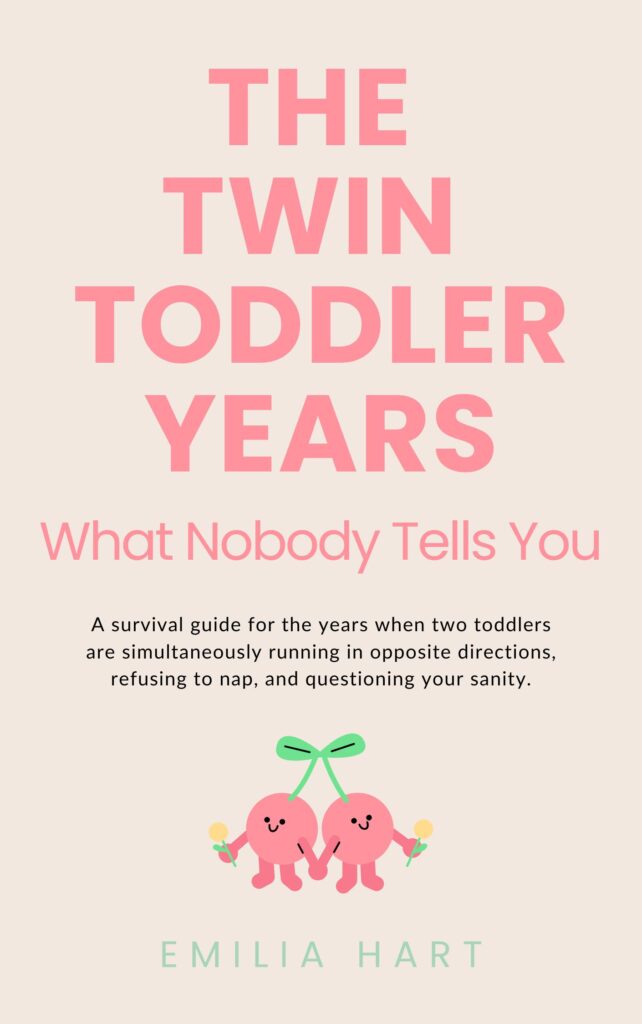
If twin life feels like a constant juggling act of tantrums, guilt, and love, The Twin Toddler Years is the survival guide you’ll actually use. It’s honest, practical, and written for the days when you just need someone to say, “You’re doing great.” 👉 View on Amazon