

There’s a moment every twin parent eventually faces — the moment both toddlers melt down at the exact same time. One is screaming because you cut their banana wrong, the other is sobbing because they wanted the blue cup, and suddenly, you’re standing in the middle of a storm with no idea who to help first. Welcome to twin tantrums, you’re in for a wild ride.
If you’re here because this keeps happening, you’re not doing anything wrong. This is twin toddlerhood — intense, emotional, overwhelming, and completely normal.
And the good news? There are ways to handle simultaneous tantrums without losing yourself in the chaos.
If you’re still transitioning out of the baby stage, you might also find comfort in my guide on Surviving the First 2 Months With Twins — because the emotional load starts long before toddlerhood. And if sleep is part of the meltdown cycle (it usually is), my post on Twin Sleep at 3–4 Months explains why early sleep patterns shape toddler behavior more than we realize. And when you’re ready for more structure, my guide on Twin Toddler Routines That Actually Work will help you build the predictability that reduces tantrums in the first place.
But today, let’s talk about the moment both toddlers lose it at once — and what you can realistically do. Because I’ve been there more times than I can count, and it didn’t exactly come easy to stay cool as a cucumber in the middle of a double meltdown. This is why these practices will save you sanity.
Why Twin Tantrums Happen at the Same Time
Twin tantrums aren’t just “double trouble.” They’re a developmental chain reaction — two nervous systems bouncing off each other like mirrors.
The reasons are simple:
- toddlers mirror each other emotionally
- one meltdown triggers the other instantly
- both want your attention at the same time
- transitions are hard for twins
- overstimulation spreads between them
- they’re still learning emotional regulation
And here’s the part that matters most: you’re not failing. You’re parenting two toddlers whose brains are still under construction — and they’re learning how to feel, express, and recover from big emotions in real time.
Twin tantrums feel bigger because they are bigger. Two nervous systems, two personalities, two triggers, one parent. It’s not you — it’s the math.
Step 1: Stay Physically Still (Even If You Feel Panicked)
When both toddlers are melting down, your instinct is to rush, fix, soothe, and move fast. But the first step is the opposite.
Pause. Plant your feet. Lower your shoulders. Take one slow breath.
Your stillness becomes their anchor.
Toddlers scan your body before they hear your words. If you’re frantic, they escalate. If you’re grounded, they soften — even if they’re still screaming.
This is the moment where you shift from “reacting” to “regulating.”
Step 2: Speak in One Short, Predictable Sentence
Twins in meltdown mode cannot process long explanations. Their brains are in fight‑or‑flight.
Use one calm line they hear every time:
- “You’re safe. I’m here.”
- “I can help one at a time.”
- “I hear you both.”
- “We’ll fix it together.”
Predictability reduces panic. Your voice becomes the constant in the chaos.
And the more often you use the same phrase, the faster they calm — because their bodies recognize the cue.
Step 3: Help the Twin Who Is Most Dysregulated First
This feels counterintuitive, but it works.
Choose the child who:
- is physically unsafe
- is screaming the hardest
- is hitting or flailing
- is closest to spiraling
You’re not choosing favorites. You’re stabilizing the situation.
The other twin may cry harder for a moment — that’s normal. But they’re watching you model calm, and that matters more than fixing everything at once.
You’re teaching them: “Help always comes. Sometimes you wait, but you’re never forgotten.”
Step 4: Use Physical Containment (Not Restraint)
Toddlers often need physical grounding to regulate.
This can look like:
- sitting on the floor
- opening your arms
- letting them come to you
- placing a hand on their back
- holding them if they lean in
You’re not forcing calm. You’re offering it.
Your body becomes the safe zone — the place where big feelings can land without judgment.
Step 5: Narrate What’s Happening (For Both Twins)
Narration helps toddlers feel seen, even if you’re only holding one.
Use simple narration:
- “You’re upset because the cup is blue.”
- “You’re upset because you wanted the banana whole.”
- “You both want me at the same time.”
Naming the feeling reduces the intensity of the feeling. It gives their brains a label for the chaos inside.
And when both feel understood, the storm starts to break.
Step 6: Switch to the Second Twin Once the First Is Stable
You’ll feel the shift — their breathing slows, their body softens, the scream becomes a whimper.
That’s your cue.
Move to the second twin and repeat:
- grounding
- narration
- calm tone
You’re teaching them patience, fairness, and emotional sequencing — skills they’ll use for years.
Step 7: Reconnect Both Twins Together
Once both are calmer, bring them close.
This is where the repair happens.
Say something like:
- “We had big feelings.”
- “We’re okay now.”
- “We can try again.”
This teaches emotional closure — something toddlers desperately need but can’t create on their own.
It also resets the sibling dynamic so they don’t carry the tension into the next activity.
What NOT to Do During Simultaneous Tantrums
❌ Don’t try to reason
Their brains can’t process logic mid‑meltdown.
❌ Don’t yell
It escalates the storm.
❌ Don’t rush
Speed increases panic.
❌ Don’t separate them unless absolutely necessary
Separation can increase fear and intensity.
❌ Don’t take it personally
This is development, not defiance.
Why Tantrums Feel Harder With Twins
Because you’re:
- outnumbered
- overstimulated
- emotionally pulled in two directions
- trying to meet two needs at once
- exhausted from constant transitions
And because you’re human.
Twin tantrums are not a reflection of your parenting — they’re a reflection of toddler development multiplied by two.
How to Reduce Simultaneous Tantrums Long‑Term
✔ Predictable routines Toddlers melt down less when they know what’s coming next.
✔ Slow transitions Give warnings, countdowns, and visual cues.
✔ Snacks + hydration Half of toddler chaos is blood sugar.
✔ Independent play Overstimulation leads to meltdowns.
✔ Earlier bedtime Overtired toddlers = emotional toddlers.
✔ One‑on‑one moments Even 5 minutes each makes a difference.
✔ Consistent phrases Repetition builds emotional safety.
✔ Lowering stimulation Soft lights, soft voice, soft pace.
What to Say Instead (Scripts for Real Moments)
When both want the same toy: “We’ll take turns. I’ll help you wait.”
When one hits the other: “Hands are for helping. I’ll help you try again.”
When they refuse to transition: “We’re going soon. Let’s count to five together.”
When you’re overwhelmed: “I need a breath. I’ll help you next.”
When both scream for you at once: “I hear you both. I can help one at a time.”
These scripts become emotional shortcuts — they help toddlers regulate faster because they know what’s coming.
The Recovery Routine (After the Tantrum)
Once calm returns:
- Offer water or a snack — physical reset.
- Keep voices soft — emotional reset.
- Do a grounding activity — books, cuddles, or music.
- Reflect later — “Next time, we’ll try counting together.”
This teaches emotional closure and self‑regulation.
The Parent Reset (Because You Matter Too)
After both are calm:
- Step outside for one minute.
- Stretch your shoulders.
- Drink water.
- Remind yourself: “I handled that.”
You’re teaching emotional regulation by modeling it — not by being perfect, but by recovering.
The Emotional Side No One Talks About
When both toddlers are screaming, it’s not just loud — it’s disorienting. It hits every sense at once. Your heart races, your shoulders tense, your brain tries to split itself in two, and suddenly you’re not just dealing with tantrums… you’re dealing with overwhelm.
And the hardest part? You’re doing it while trying to stay calm, gentle, patient, and emotionally available — all at the same time.
You feel:
- overstimulated to the point your skin buzzes
- guilty for not knowing who to help first
- helpless because nothing seems to work
- frustrated because you’re only one person
- touched out from constant physical contact
- mentally drained from the nonstop emotional load
And then, when the storm finally passes, you’re left with the aftershocks — the self‑doubt, the exhaustion, the “I should’ve handled that better,” the “why is this so hard,” the “am I messing them up,” the “I can’t do this again tomorrow.”
But here’s the truth no one says out loud:
Twin tantrums are one of the hardest parts of raising multiples. Not because you’re doing something wrong — but because you’re doing the work of two parents at once.
You’re regulating two nervous systems. You’re absorbing two emotional storms. You’re meeting two sets of needs with one body and one brain. You’re carrying twice the noise, twice the intensity, twice the pressure.
And you’re doing it while still trying to be gentle, loving, patient, and present.
That’s not weakness. That’s not failure. That’s not “not coping.”
That’s superhuman.
And even superhumans get overwhelmed.
You’re not supposed to handle twin tantrums effortlessly. You’re supposed to handle them with the tools you have, the patience you can muster, and the love that keeps you going even when you’re exhausted.
And you’re doing that — every single day.
Want More Support Through the Toddler Stage?
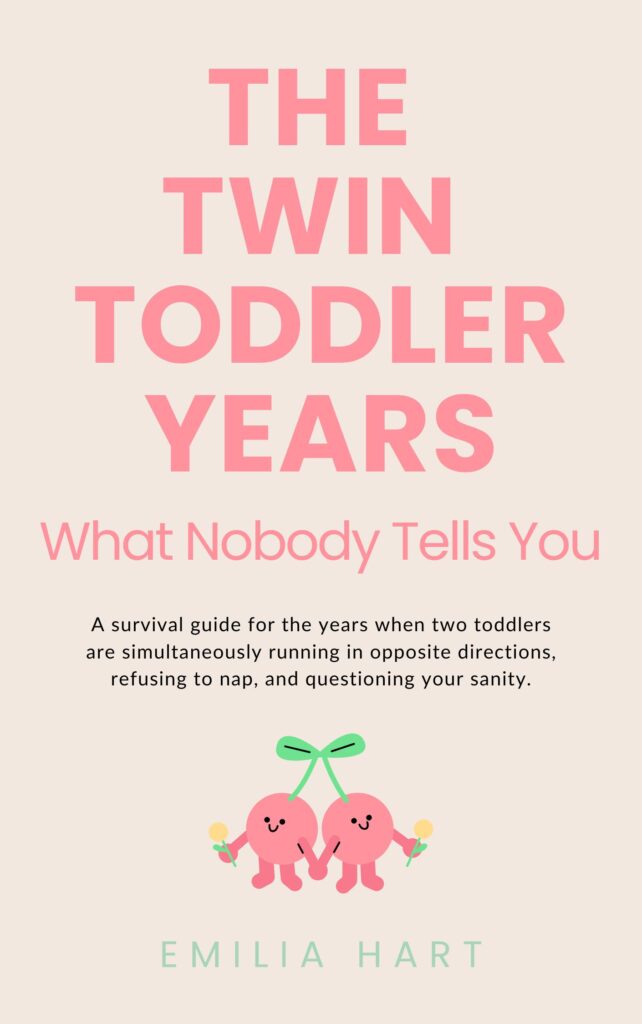
If you’re craving deeper guidance — not just tips, but real scripts, real routines, real emotional tools — my book The Twin Toddler Years was written exactly for this season.
Inside, you’ll find:
- step‑by‑step tantrum scripts
- how to reduce sibling rivalry
- how to build independence in twins
- how to create routines that actually work
- how to stay calm when both toddlers lose it
- how to manage overstimulation and burnout
- how to reconnect after hard moments
- how to support two completely different personalities at once
It’s the book I wish I had when I was drowning in double meltdowns, double demands, and double the emotional load.
If you want your days to feel calmer, more predictable, and more manageable — not perfect, just possible — this is your next step.
You don’t need perfection. You need support, tools, and a plan that understands the reality of raising two toddlers at once.
And you deserve that — truly.