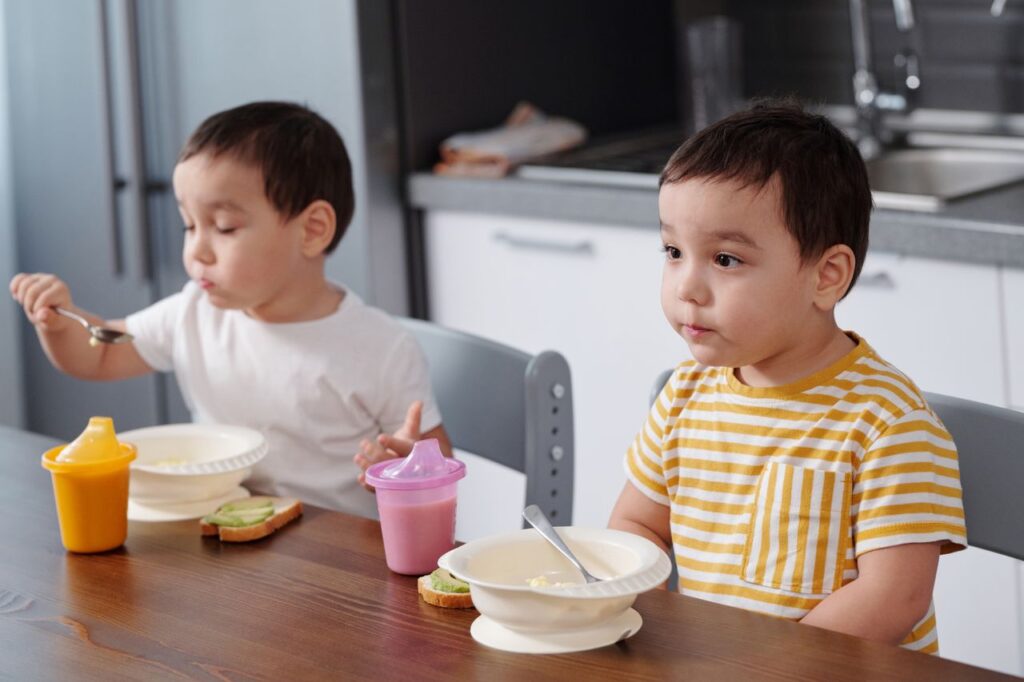
If you have twin toddlers, you may have reached the point where mealtime feels less like eating and more like watching food fly across the room. If you’re wondering how to get twin toddlers to stop throwing food, you’re definitely not alone.
One twin throws a piece of banana.
The other sees it happen and immediately launches a piece of toast.
Then suddenly you’re standing there wondering how two small children can create quite so much mess in five minutes.
If your twin toddlers are throwing food, you’re not necessarily dealing with a serious eating problem. Food throwing is a common part of toddler development. Young children are still learning how to eat, testing boundaries, exploring cause and effect, and figuring out how much independence they have at the table.
But that doesn’t mean you have to accept food being thrown throughout every meal.
The good news is that you can respond consistently without turning every meal into a battle.
Why do toddlers throw food?
Before trying to stop the behavior, it helps to understand why it’s happening.
Your toddler might be throwing food because:
- They’re finished eating.
- They’re not very hungry.
- They’re bored.
- They’re experimenting with what happens when food hits the floor.
- They’re frustrated.
- They’re trying to get your attention.
- They’re copying their sibling.
- They’re testing a boundary.
- They’re simply playing with their food.
And with twins, there’s an additional possibility:
One twin may start throwing food because the other one did it.
Twins are constantly watching each other. What starts as one toddler dropping a piece of food can quickly become a shared mealtime activity.
Toddlers also naturally have unpredictable appetites. Their growth slows after infancy, so it’s normal for them to eat a lot at one meal and very little at another.
That means you don’t necessarily need to convince them to finish what’s on their plates.
Your job is to provide appropriate food. Their job is to decide whether and how much they eat.
If your twins are constantly looking for something to do, you might also want to try these 15 Twin Toddler Activities That Keep Both Kids Busy between meals to keep them from being bored.
1. Don’t make food throwing exciting
This is probably one of the hardest things to do when you’re already exhausted.
Your toddler throws a piece of food.
You immediately say:
“NO! Don’t throw your food!”
They look at you.
You react again.
They throw another piece.
Now you’ve accidentally created a very entertaining game.
Toddlers are fascinated by reactions, and food throwing can become more interesting when it consistently produces a big response. Staying calm and making the behavior boring can help reduce its appeal.
You don’t need to pretend nothing happened.
Just keep your response simple.
“Food stays on the table.”
Then calmly pick up the food when appropriate.
No lecture. No yelling. No dramatic reaction.
2. Teach them what they CAN do
Simply saying “don’t throw your food” isn’t always enough.
Toddlers need to learn what to do instead.
You can say:
“If you don’t want it, put it here.”
Then give them a designated place for unwanted food.
This could be:
- A small “no thank you” bowl.
- The edge of their plate.
- A section of their divided plate.
The goal isn’t to create complicated mealtime rules.
You’re teaching one simple alternative:
Food stays on the table. If you don’t want it, you can leave it there.
3. Watch for the “I’m finished” signal
Sometimes food throwing is your toddler’s way of saying:
I’m done.
If you’ve noticed that your twins start throwing food after eating for a while, don’t assume they’re suddenly misbehaving.
They may simply be finished.
You can teach a simple phrase or gesture:
“All done.”
When they signal that they’re finished, you can calmly end their meal.
This can be particularly helpful with twins because you may have one child who is finished while the other is still happily eating.
You don’t have to make both children stay at the table until they finish at exactly the same time.
4. Don’t force them to eat
It can be incredibly frustrating to prepare food for two toddlers only to watch one of them throw it on the floor.
But trying to force them to eat can turn mealtimes into a power struggle.
The American Academy of Pediatrics recommends avoiding pressure around eating and allowing toddlers to decide how much they eat from the foods offered.
Instead of:
“You need to eat your chicken.”
Try:
“Here’s your dinner. You can decide what you want to eat.”
You’re still providing the food and setting boundaries around behavior.
You’re just not turning eating into a battle.
If you’re still in the newborn stage, you may also find the guide to Feeding Twins in the First 3 Months helpful.
5. Give them smaller portions
This is especially useful with toddlers who throw food frequently.
You don’t need to put a huge amount of food on their plates.
Start with a small portion.
If they’re still hungry, they can have more.
Smaller portions also mean less food ends up on the floor when your toddler decides they’re finished.
And because toddler appetites can vary significantly from day to day, a small meal doesn’t necessarily mean your child isn’t getting enough food overall.
If you’re not sure what to serve them, check out Quick Toddler Meals for Days When They Refuse Everything.
6. Don’t give both twins the same amount just because they’re twins
This is one of those things that can make twin parenting unnecessarily complicated.
Your twins are two different people.
One might be hungry.
The other might not be.
One might eat three strawberries.
The other might eat one.
One might need more food.
The other might announce they’re finished after two bites.
That’s okay.
You don’t have to make every aspect of their meals identical.
If one twin asks for more, give them more.
If the other is finished, let them be finished.
Trying to make twins eat exactly the same amount can create unnecessary stress for everyone.
7. Don’t immediately replace a rejected meal
If your toddler throws their dinner and you immediately offer their favorite food instead, they can learn that throwing food is a very effective way to change the menu.
That doesn’t mean you should force a hungry child to go without food.
It means you don’t have to become a short-order cook every time your toddler rejects what’s on the table.
Try to include at least one familiar food your child generally likes alongside the rest of the meal. This gives them something they feel comfortable with while still allowing them to decide what and how much to eat.
8. Have one simple rule for both twins
With twins, consistency becomes even more important.
You don’t need ten different mealtime rules.
Choose one or two that you can actually enforce.
For example:
“Food stays on the table.”
“If you’re finished, say all done.”
That’s it.
When one twin throws food, respond the same way you would when the other twin does it.
You don’t need a completely different reaction for each child.
9. Don’t turn the floor into a game
If your twins are deliberately dropping food just to watch you pick it up, try not to become part of the game.
Stay calm.
You can say:
“Food stays on the table.”
Then move on.
You don’t necessarily have to pick up every single piece immediately. Some parents find it easier to leave the dropped food until the meal is finished and clean everything up afterward.
A washable mat under the table can also make this stage considerably less stressful.
Sometimes the goal isn’t to eliminate every piece of mess.
It’s simply to stop the mess from driving you crazy.
10. Expect some food throwing
This may be the most important part.
Your goal probably isn’t:
“My toddlers will never throw food again.”
That’s unrealistic.
Your goal is:
“Food throwing isn’t going to turn every meal into chaos.”
Toddlers are still learning.
There may be a week where things improve and then suddenly you’re back to picking pasta off the floor.
That’s normal.
Keep your response predictable.
Keep the boundary simple.
And avoid making the behavior more exciting than it needs to be.
What if one twin throws food and the other immediately copies?
Welcome to twin parenting.
This is one of the unique challenges of having twins.
Sometimes you’re not dealing with one toddler experimenting with a behavior.
You’re dealing with two toddlers reinforcing each other’s behavior.
If one twin throws food and the other copies, try not to react dramatically to either child.
Calmly remind them:
“Food stays on the table.”
Then redirect them toward eating.
If they’re both clearly finished, end the meal.
The less exciting the behavior becomes, the less rewarding it is as a shared game.
When should you be concerned?
Occasional food throwing is generally part of normal toddler behavior.
But if you’re concerned about your child’s eating, growth, chewing, swallowing, or ability to eat a reasonable variety of foods, talk with your child’s pediatrician or another qualified health professional.
And remember that one difficult meal doesn’t tell you everything about your toddler’s nutrition. Toddlers can eat very different amounts from one meal or day to another. Looking at eating patterns over time can give you a much more useful picture.
The twin toddler mealtime rule I keep coming back to
You don’t have to win every meal.
You don’t have to make your twins eat everything you serve.
And you definitely don’t have to spend dinner yelling:
“STOP THROWING YOUR FOOD!”
Instead, keep it simple.
You provide the food.
They decide whether and how much to eat.
You set the boundary that food stays on the table.
And when the inevitable piece of toast hits the floor?
Take a breath.
You’re parenting toddlers.
And you’re parenting two of them at the same time.
This phase won’t last forever.
If mealtimes with twins feel harder than you expected…
You’re not alone.
Raising twins means dealing with twice the opinions, twice the moods, and sometimes twice the food on the floor.
The goal isn’t to create a perfectly behaved twin household.
It’s to find practical ways to make everyday life feel a little calmer and more manageable.
That’s exactly what Double Joy Life is about.
Want Everyday Life With Twins to Feel a Little Calmer?
Food throwing is just one of the many little challenges that can make life with twins feel overwhelming. When you’re dealing with two toddlers, it’s often the accumulation of small, difficult moments that leaves you feeling exhausted.
The Calm Twin Life System was created to help you navigate those everyday challenges with practical strategies you can actually use—not a perfect routine or another list of things you’re supposed to be doing.