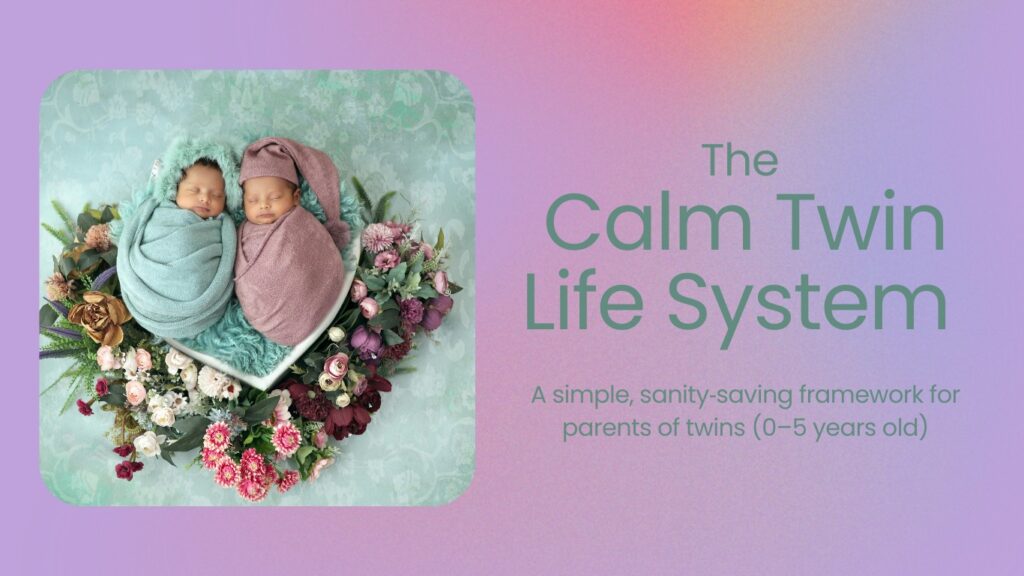

What gets easier after 3 months with twins isn’t a single moment or a magical turning point — it’s a slow shift that happens underneath the exhaustion. Those first three months can feel endless: survival mode is constant, sleep is fragmented, and every day blends into the next as you run on instinct, adrenaline, and whatever scraps of energy you can find. You’re doing everything for two babies who need you constantly, and there’s barely time to breathe, let alone process what’s happening.
So when people say, “It gets easier after three months,” it’s natural to hope for a dramatic change — a day when everything suddenly feels lighter. You imagine waking up and realizing you’ve crossed some invisible threshold where routines make sense, babies are calmer, and you finally feel like yourself again.
But the truth is more layered. Some things genuinely do ease after the early weeks. Others don’t — they simply evolve into a different kind of hard. The shift is real, but it’s subtle. It’s not a single moment; it’s a gradual transition where certain parts of twin life begin to feel more manageable while others still demand everything you have.
Here’s an honest look at what gets easier after 3 months with twins, and what often doesn’t.
What Usually Gets Easier After 3 Months
Feeding becomes more predictable
Whether you’re breastfeeding, bottle‑feeding, or combo feeding, many parents notice more rhythm around feeds. Sessions may shorten. Babies may take fuller feeds. You’re less likely to feel like you’re feeding nonstop around the clock. You may even start to see the beginnings of a pattern — not a schedule, but a sense of what’s coming next.
You also become more confident in how you feed your twins. You stop second‑guessing every choice. You know what works for your babies, and that alone makes feeding feel less overwhelming.
If you’re still in the thick of early feeding chaos, you may find comfort in Feeding Twins in the First 3 Months, which breaks down what’s normal in those early weeks.
Sleep stretches may lengthen
You might start seeing longer nighttime stretches — not consistently, and not every night, but enough to feel a difference. Even one longer stretch can change how you feel the next day. You may notice your babies settling a bit easier or waking slightly less frequently.
But sleep is still fragile at this age. Many parents report improvement at this stage, but for my twins it took much longer for sleep to improve. It’s common to have a few good nights followed by a sudden regression. This doesn’t mean you’re doing anything wrong — it’s simply how twin sleep unfolds.
Babies become more interactive
Smiles, eye contact, cooing, and early laughter begin to appear. These moments matter. They offer emotional return during a phase that previously felt one‑sided. You start to feel connected in a new way — not just needed, but seen. Your babies begin responding to your voice, your face, your presence. That connection can carry you through some of the harder days.
You also start to see glimpses of their personalities — tiny differences that make each twin feel wonderfully unique.
Handling twins feels less shocking
You don’t suddenly feel confident — but you do feel less panicked. Basic care becomes more automatic. You’re no longer Googling every sound or movement. You know your babies better. You understand their cues. You can anticipate what’s coming next.
This familiarity alone makes the days feel more manageable. You’re still tired, still stretched thin, but you’re not operating in the same level of crisis mode. You’ve learned how to move through the chaos with more steadiness.
Your body begins to stabilize
Hormones start to settle. Physical recovery improves. You may still feel tired, but less raw than in the earliest weeks. Your appetite steadies. Your emotions feel less like a roller coaster. You may notice moments where you feel grounded again — even if they’re brief.
You’re not “back to normal,” but you’re no longer in the free‑fall of the newborn phase. Your body begins to feel like it’s supporting you instead of fighting you.
What Often Doesn’t Get Easier (Yet)
Sleep is still unpredictable
While stretches may lengthen, sleep is rarely stable at this age. Naps can be short. Nights can regress. Routines may fall apart without warning. You may feel like you’re constantly adjusting, constantly troubleshooting, constantly hoping tonight will be better.
Twin sleep is a long game. Improvement comes, but not always on the timeline people promise.
The mental load increases
As twins become more alert, you’re not just meeting physical needs — you’re managing stimulation, wake windows, schedules, and overlapping demands. You’re tracking two babies’ cues, two babies’ moods, two babies’ needs. You’re trying to keep both regulated, both fed, both rested, both comforted — often at the same time.
This is when many parents feel the invisible weight of twin parenting intensify. You’re doing more, thinking more, planning more — and often with less support than in the newborn phase.
Leaving the house is still hard
Even when feeds and naps are more spaced out, logistics remain complex. Getting two babies ready, fed, dressed, and calm takes time and planning. Outings require strategy, not spontaneity. You may feel more capable — but not necessarily more mobile.
Many twin parents stay home more during this stage simply because the effort of leaving feels bigger than the benefit.
Emotional exhaustion lingers
The adrenaline of the newborn phase fades, and deeper fatigue surfaces. You’re no longer in crisis mode, but you’re not rested either. This is when burnout often creeps in quietly. You may feel stretched thin, depleted, or emotionally flat — not because you’re doing anything wrong, but because twin parenting is demanding in ways most people never experience.
Comparison becomes more noticeable
Differences in sleep, temperament, and development often emerge more clearly after three months. One twin may be more alert, one more sensitive, one more vocal, one more active. These differences can trigger worry, guilt, or self‑doubt — especially when you’re tired.
If comparison is weighing on you, Comparing Twins: How to Stop (and Why It Happens) offers grounding perspective.
Why the Shift Feels Confusing
After three months, you’re no longer in pure survival — but you’re not in ease either. You’re in the in‑between. You’re doing more, but support may decrease. Expectations rise, even though the workload remains heavy. People assume you’re “past the hard part,” even though you’re still deep in it.
That mismatch can be harder than the early chaos. You may feel like you should be coping better, even though the demands haven’t actually decreased.
Sleep changes are common during this time — Twin Sleep in the First 6 Months breaks down what’s normal so you don’t feel like you’re doing something wrong.
How to Think About “Easier” More Realistically
Instead of asking whether things are easier, try asking:
- What feels more familiar?
- What requires less mental effort?
- Where can I simplify expectations?
- What can I let go of for now?
Ease comes in pieces, not all at once. And sometimes the pieces are small — but meaningful. A slightly longer nap. A calmer feed. A moment where both babies are content. A day where you feel more like yourself.
These small shifts matter.
What Helps During This Phase
Lower the bar intentionally
You don’t need to optimize routines or schedules yet. Stability matters more than perfection. Predictability grows slowly — not instantly. Give yourself permission to do what works, not what looks ideal.
Protect sleep where you can
Even small improvements to rest make a difference. Focus on consistency over control. You’re not training — you’re supporting. And supporting sleep at this age is about gentle patterns, not strict rules.
Allow mixed feelings
It’s okay to feel grateful and exhausted at the same time. It’s okay to love your babies and still feel overwhelmed. It’s okay to want help even when things are “better.”
Both can exist. Both are valid.
Keep asking for support
Just because the newborn phase is over doesn’t mean you no longer need help. In fact, this stage often requires more support, not less. You’re carrying a heavy load — you deserve backup.
This Phase Still Counts as Hard
If things don’t feel dramatically easier after three months, you’re not behind and you’re not doing anything wrong. Some things improve. Others remain challenging. And that’s normal with twins. The three‑month mark isn’t a finish line — it’s a transition point. You’re moving out of the raw intensity of the newborn phase, but you’re stepping into a stage that still asks a lot from you. Many parents expect relief and instead find themselves carrying a different kind of hard.
It’s easy to assume that ease should arrive on a predictable timeline, especially when people around you say, “It gets better after three months.” But twin parenting doesn’t follow a universal schedule. Your babies are individuals. Your recovery is individual. Your circumstances are individual. The pace at which things shift is not a reflection of your capability — it’s simply the reality of raising two infants at once.
Progress is happening — even when it doesn’t feel like relief yet. It often shows up quietly: a feed that goes smoother, a nap that lasts longer, a moment where both babies are content, a day where you feel steadier than the one before. These changes can be subtle, almost easy to miss, especially when you’re tired. But they’re real. They’re accumulating. They’re shaping the foundation of what comes next.
You’re moving forward, even if the steps are small. You’re learning your babies, adapting constantly, and making decisions in real time with limited rest and limited margin. You’re showing up in a season that demands more than most people will ever understand. And you’re doing an incredible job — not because everything feels easier, but because you’re navigating a phase that is still objectively hard with persistence, care, and the kind of resilience that twin parenting builds in you day by day.
Ease will come in pieces. And until it does, you’re allowed to acknowledge that this stage is still heavy — and that you’re doing the work anyway.
Bottom Line
Some things get easier, some don’t — but you don’t have to do it alone. The Calm Twin Life System helps you focus on what truly matters.