Independent play with twin toddlers is one of the greatest gifts you can give yourself — and them. It’s not just about getting ten minutes to drink your coffee while it’s still warm or finally switching the laundry without someone hanging off your leg. It’s about giving your twins the chance to discover who they are as individuals, not just as a pair. It’s about helping them build confidence, emotional regulation, problem‑solving skills, frustration tolerance, and the ability to exist without constant stimulation or attention. Independent play is where toddlers learn to explore, experiment, and make decisions — and for twins, it’s one of the few moments where they get to experience themselves without the immediate influence of their sibling.
But here’s the truth twin parents rarely say out loud: independent play is harder with twins. Much harder. Not because your twins are “clingy,” “needy,” or “bad at playing alone,” but because the twin dynamic itself complicates independence. Two toddlers at the same developmental stage, with the same emotional intensity, the same desire for your attention, and the same instinct to mirror each other’s behaviour — that’s a lot. When one twin gets upset, the other often follows. When one wants the toy, suddenly both want it. When one needs you, the other realizes they need you too. Independence becomes a shared emotional negotiation instead of a simple developmental skill.
So if your twins cling to you, fight over toys, or melt down the moment you step away, you’re not imagining it. You’re not doing anything wrong. You’re not failing because independent play isn’t happening “naturally.” Twin dynamics make independence more complicated — but not impossible. And the fact that it’s harder doesn’t mean it’s out of reach. It just means you need a different approach, one that respects their relationship, their temperament, and their emotional needs.
This guide will help you understand why independent play is challenging for twins, and how to build it slowly, realistically, and in a way that supports both toddlers’ nervous systems. You’ll learn how to create environments that reduce conflict, how to use parallel play as a bridge to independence, how to support each twin’s individual needs, and how to step back without triggering chaos. Independent play isn’t a switch you flip — it’s a skill you nurture. And with the right strategies, your twins can learn to explore, play, and regulate themselves without needing you every second.
Why Independent Play Is Harder for Twin Toddlers
Twin toddlers have a unique emotional ecosystem. They’re deeply connected, easily triggered by each other, and often rely on you to mediate their world.
Here’s why independent play feels harder for twins:
- They mirror each other’s emotions instantly
- They compete for your attention
- They fight over toys even when there are duplicates
- They struggle with separation — even from you, even for a moment
- They rely on you to regulate their nervous systems
- They get overstimulated faster when they’re together
If your twins fight over everything, you’re not alone — and you’ll find support in my guide on Why Twins Fight Over Everything (And What You Can Do About It), which explains the developmental reasons behind constant conflict.
Independent play isn’t just a skill. It’s a developmental milestone — and twins reach it differently.
What Independent Play Actually Means for Twin Toddlers
Independent play doesn’t mean your twins sit quietly in separate corners for 30 minutes while you fold laundry. That’s not realistic, and it’s not developmentally appropriate.
Independent play for twins looks like:
- short bursts of solo play
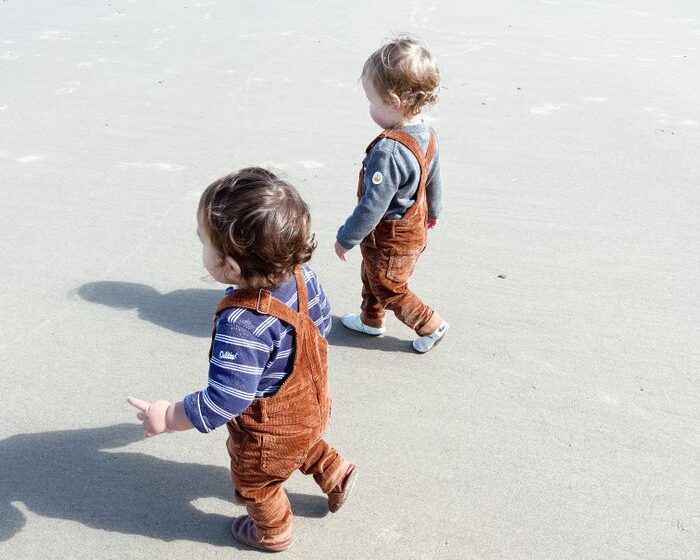
- parallel play where they’re near each other but not interacting
- exploring toys without needing you to narrate or guide
- staying regulated without constant intervention
- being able to tolerate small frustrations without melting down
It’s messy. It’s loud. It’s imperfect. And it’s still progress.
Step 1: Start With Parallel Play, Not Solo Play
Twin toddlers often need to be near each other to feel safe. Asking them to play separately right away can trigger anxiety, clinginess, or conflict.
Parallel play is the bridge.
Set up two similar play stations:
- two baskets of blocks
- two sets of stacking cups
- two simple puzzles
- two identical dolls or cars
Place them side by side, not across the room.
Your twins will:
- feel secure
- feel equal
- feel less competitive
- stay regulated
- be more willing to explore on their own
Parallel play is the foundation of independent play. Build it slowly.
Step 2: Use Containment Play to Reduce Chaos
Twin toddlers often need physical boundaries to feel safe enough to explore independently.
Containment play options:
- a gated play area
- a playpen big enough for both
- a small room with a closed door
- a defined rug or mat
- a toddler table with two chairs
Boundaries reduce overstimulation and fighting. They also help you step back without chaos erupting.
If your twins tend to melt down at the same time, containment play helps regulate the environment — and you can find more support in How to Handle Twin Tantrums When They Happen at the Same Time.
Step 3: Create a Yes‑Space That Encourages Exploration
A yes‑space is a safe environment where your twins can explore without constant correction.
This means:
- no fragile items
- no unsafe furniture
- no toys with tiny pieces
- no clutter
- no overstimulating bins
A yes‑space gives your twins the freedom to explore without needing you to hover.
Independent play thrives in simplicity.
Step 4: Rotate Toys to Reduce Overwhelm
Twin toddlers get overstimulated easily. Too many toys = too much chaos.
Rotate toys weekly:
- one sensory bin
- one building toy
- one pretend play item
- one puzzle
- one gross motor item
Less choice = more focus.
More focus = more independence.
Step 5: Use Short, Predictable Play Intervals
Twin toddlers need structure to feel safe enough to explore independently.
Start with:
- 3 minutes
- then 5 minutes
- then 7 minutes
- then 10 minutes
Use a visual timer so they know what to expect.
Predictability reduces anxiety and increases confidence.
Step 6: Narrate Before You Step Away
Twin toddlers need emotional preparation before you leave the play space.
Use one simple line:
“You’re safe. I’ll be right over here.”
Or:
“I’m close. You can play. I’ll come back.”
This reduces panic and clinginess.
If one twin needs more attention and struggles when you step away, you’ll find helpful scripts in When One Twin Toddler Needs More Attention: How to Handle It Fairly Without Losing Yourself.
Step 7: Stay Close, But Not Involved
This is the magic zone.
Sit nearby:
- on the couch
- at the table
- on the floor but not in the play area
Your presence regulates them.
Your distance encourages independence.
You’re close enough to feel safe, but far enough to let them explore.
Step 8: Use Simple, Open‑Ended Toys
Independent play thrives with toys that don’t require instructions.
Best options:
- blocks
- stacking cups
- play silks
- wooden animals
- cars
- dolls
- shape sorters
- simple puzzles
Avoid toys that:
- light up
- make noise
- talk
- require adult involvement
- overstimulate
Open‑ended toys = longer play.
Step 9: Teach Conflict Resolution Before You Step Back
Twin toddlers fight. Constantly. It’s developmentally normal.
But conflict can derail independent play instantly.
Teach simple scripts:
- “You can take turns.”
- “You can trade.”
- “You can play beside each other.”
- “You can use the other basket.”
Practice these scripts during connected play so they can use them during independent play.
Step 10: Build One‑on‑One Play Into Your Routine
Independent play improves dramatically when each twin gets small pockets of one‑on‑one time.
Even 5 minutes each:
- reading
- building
- cuddling
- playing with a single toy
One‑on‑one time fills their emotional cup.
A full cup = more independence.
Step 11: Expect Regression During Transitions
Twin toddlers regress during:
- teething
- illness
- sleep changes
- dropping to one nap
- developmental leaps
- big emotions
- routine changes
Regression is normal.
It’s not a failure.
It’s not a sign they “can’t” do independent play.
It’s a sign they need more connection temporarily.
Step 12: Celebrate Small Wins
Independent play grows slowly.
Celebrate:
- 2 minutes of solo play
- exploring a toy without you
- playing beside each other peacefully
- solving a small conflict
- staying regulated when you step away
These small wins build the foundation for longer independent play later.
What Independent Play Looks Like at Different Ages
12–18 months
- short bursts
- parallel play
- exploration
- sensory play
- simple toys
18–24 months
- longer intervals
- simple pretend play
- more problem‑solving
- more conflict resolution
24–36 months
- imaginative play
- longer focus
- more independence
- more cooperation
Twin toddlers follow their own timeline. There is no “late.” There is only development.
The Emotional Side No One Talks About
Encouraging independent play isn’t just about your twins.
It’s about you.
You need:
- breaks
- quiet
- mental space
- time to breathe
- time to reset
- time to exist as a human
Independent play supports your mental load — and if you’re feeling overwhelmed, you’ll find comfort in Easing the Mental Load of Twin Parenting.
You’re not selfish for wanting space.
You’re human.
Final Thoughts: Independent Play Is a Skill, Not a Personality Trait
Your twins are not “bad at independent play.”
They are learning.
They are growing.
They are figuring out how to exist in a world that is loud, emotional, overwhelming, and shared with another toddler who wants the same toy at the same time.
Independent play is possible.
It will grow.
It will get easier.
And you’re doing better than you think.
A little extra support for your twin parenting journey
If you’re craving more calm, more clarity, and more “okay, I can actually do this,” I’ve put together a collection of twin‑specific resources designed to make your days easier — without adding more overwhelm. You’ll find everything on the Twin Parenting Books & Resources page.