
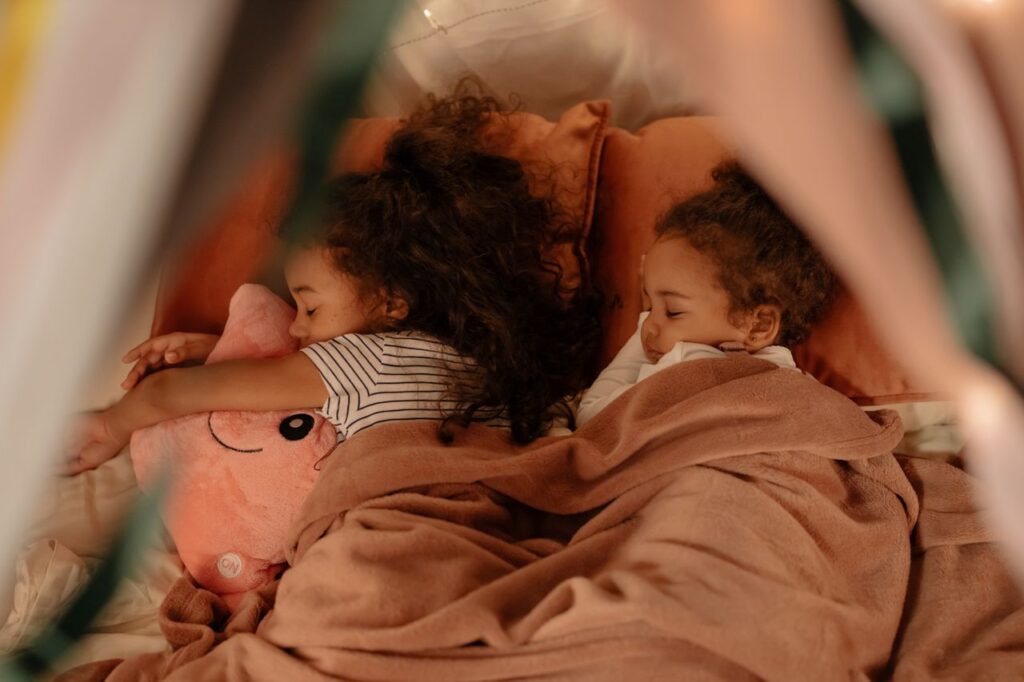
Bedtime with twin toddlers is a full emotional event. It’s loud, unpredictable, and somehow always more dramatic than the night before. One twin wants water. The other suddenly needs a different pajama top. Someone is crying. Someone is laughing. Someone is running naked down the hallway. And you’re standing there thinking, How is bedtime this chaotic every single night? It feels like the moment the clock hits bedtime, your home transforms into a tiny, twin‑powered circus.
If bedtime feels like a battle, you’re not alone. A twin toddler bedtime routine comes with a unique intensity that singleton parents simply don’t experience. It’s not because you’re doing anything wrong. It’s because bedtime is the moment when two toddlers with big emotions, tired bodies, and competing needs collide. Their nervous systems are overloaded. Their patience is gone. Their impulse control is nonexistent. And their desire for your attention skyrockets — at the exact same time.
Twin toddlers don’t just struggle with bedtime; they amplify it. One twin stalls, and the other copies. One twin melts down, and the other follows. One twin decides they’re suddenly terrified of the dark, and the other decides they are too. Their emotional worlds are intertwined, and bedtime is the perfect storm where everything spills out at once.
But here’s the good news: a bedtime routine can work. A bedtime routine can feel calmer. And your twins can learn to settle, even when they stall, resist, negotiate, or try every trick in the toddler handbook. You don’t need perfection. You don’t need a rigid schedule. You don’t need to become a bedtime drill sergeant. You just need a routine that supports their nervous systems, respects their developmental stage, and gives them the connection they crave before sleep.
This guide will walk you through a twin toddler bedtime routine that actually works — one that reduces chaos, minimizes stalling, and helps your twins transition from high energy to deep rest. It’s built for real life, not fantasy. It’s built for twin dynamics, not singleton norms. And most importantly, it’s built to help you end the day without feeling like you’ve run a marathon in the dark with two tiny emotional tornadoes.
You deserve calmer nights. Your twins deserve a routine that helps them settle. And yes — even in the chaos — a bedtime routine that actually works is absolutely possible.
Why Bedtime Is Harder With Twin Toddlers
Twin toddlers don’t just experience bedtime — they amplify it.
Here’s why bedtime feels so intense:
- They mirror each other’s emotions instantly
- They compete for your attention
- They get overstimulated easily
- They struggle with transitions
- They feed off each other’s energy
- They want the same thing at the same time
- They sense your exhaustion and react to it
Even if you’ve had a smooth day, bedtime can unravel quickly because toddlers are biologically wired to fall apart at the end of the day. Their emotional regulation is lowest. Their patience is lowest. Their ability to cope is lowest. And with twins, everything doubles — the needs, the noise, the intensity.
If your twins fight during bedtime, you’ll find support in Why Twins Fight Over Everything (And What You Can Do About It) — it explains the developmental reasons behind constant conflict.
What a Twin Toddler Bedtime Routine Needs to Work
A bedtime routine for twins needs three things:
- Predictability Toddlers thrive on knowing what comes next.
- Simplicity Too many steps = too many opportunities for chaos.
- Connection Toddlers settle better when they feel emotionally full.
If your routine is too long, too complicated, or too rushed, your twins will stall, resist, or melt down. The goal is not perfection — it’s consistency.
The Twin Toddler Bedtime Routine That Actually Works
Below is a routine designed specifically for twin toddlers — simple, predictable, and emotionally grounding.
You can adjust the timing, but keep the order the same. Order is what creates safety.
Step 1: The Slow‑Down Window (20–30 minutes before bedtime)
Bedtime starts before bedtime.
The slow‑down window is the transition between chaos and calm. Without it, toddlers go into bedtime overstimulated — and overstimulation is the root of most bedtime battles.
What the slow‑down window looks like:
- dim lights
- quiet play
- no screens
- no roughhousing
- no loud toys
- no sugar
- no new activities
Great slow‑down activities:
- puzzles
- books
- coloring
- simple blocks
- gentle music
- snuggling on the couch
This window signals to your twins’ nervous systems: We’re shifting into calm.
Step 2: Bath or Wipe‑Down (5–10 minutes)
Bath time is optional — not required.
If baths overstimulate your twins, skip them. A warm wipe‑down works just as well and keeps the routine predictable.
Bath tips for twins:
- keep it short
- keep it calm
- avoid new bath toys
- avoid splashing competitions
- avoid sibling comparisons (“Who can wash faster?”)
Bath time is not playtime. It’s a sensory reset.
Step 3: Pajamas + Diapers (5 minutes)
This is where stalling begins.
Twin toddler stalling behaviors:
- “I want different pajamas!”
- “I don’t like these socks!”
- “I need to pee again!”
- “I want to do it myself!”
- “I don’t want to wear clothes!”
To reduce stalling:
- offer two choices (not unlimited options)
- keep pajamas in a small rotation
- avoid last‑minute changes
- narrate the transition (“Pajamas, then books.”)
Toddlers settle better when they know what’s next.
Step 4: Brush Teeth (2–3 minutes)
This is often the most chaotic part of bedtime.
Twin toddler tooth‑brushing tips:
- brush together (reduces competition)
- use a song
- use a timer
- let them “brush first”
- finish the job yourself
Toddlers love control. Give them a small piece of it.
Step 5: The Connection Pocket (5 minutes)
This is the most important part of bedtime — and the part most parents skip because they’re exhausted.
The connection pocket is a short moment of one‑on‑one attention that fills your twins’ emotional cups before sleep.
Connection pocket ideas:
- a short cuddle
- a simple story
- a calming song
- a gentle back rub
- a quiet conversation (“What was your favorite part of today?”)
Even 2 minutes each makes a huge difference.
If one twin needs more attention and struggles during bedtime, you’ll find support in When One Twin Toddler Needs More Attention: How to Handle It Fairly Without Losing Yourself.
Step 6: Books (5–10 minutes)
Books are the anchor of bedtime.
Tips for twin toddler reading:
- choose short books
- avoid new stories at bedtime
- read on the floor or bed
- keep the lights dim
- avoid overstimulating voices or sound effects
Books regulate toddlers. They slow breathing, slow movement, and slow the nervous system.
Step 7: The Bedtime Script (1 minute)
Toddlers need a predictable script — the same words every night.
A simple bedtime script:
“You’re safe. I love you. It’s time for sleep. I’ll check on you.”
This script reduces separation anxiety and bedtime stalling.
Step 8: Lights Out (1 minute)
Lights out should be calm, quiet, and predictable.
Tips:
- use blackout curtains
- use a dim red nightlight if needed
- avoid talking after lights out
- avoid negotiating
- avoid adding new steps
Lights out is the boundary.
Step 9: The Check‑In Method (5–10 minutes)
Twin toddlers often need reassurance after lights out.
Use predictable check‑ins:
- 2 minutes
- 5 minutes
- 10 minutes
Check‑ins should be:
- brief
- calm
- quiet
- consistent
Do not restart the routine. Do not negotiate. Do not add new requests.
Check‑ins help toddlers settle without feeling abandoned.
Why Twin Toddlers Stall at Bedtime
Stalling is not misbehavior — it’s communication.
Twin toddlers stall because:
- they want more connection
- they fear separation
- they’re overtired
- they’re overstimulated
- they’re dysregulated
- they’re testing boundaries
- they’re mirroring each other’s anxiety
Stalling is developmentally normal.
Your job is not to eliminate stalling — it’s to reduce it.
How to Handle Bedtime Battles Without Losing Your Mind
Bedtime battles happen. Here’s how to handle them calmly.
1. Stay predictable
Toddlers settle when you stay consistent.
2. Stay calm
Your energy sets the tone.
3. Don’t negotiate
Negotiation teaches toddlers to stall more.
4. Keep the routine short
Long routines create more opportunities for chaos.
5. Reduce stimulation
Toddlers cannot settle when overstimulated.
6. Use simple scripts
Scripts reduce emotional overwhelm.
What to Do When Both Twins Melt Down at Bedtime
Twin meltdowns at bedtime are intense — and common.
If both melt down:
- lower your voice
- sit on the floor
- breathe slowly
- narrate what’s happening
- offer physical comfort
- reset the environment
For deeper strategies, see How to Handle Twin Tantrums When They Happen at the Same Time.
The Emotional Side of Twin Bedtime No One Talks About
Bedtime is not just hard for toddlers — it’s hard for you.
By bedtime:
- your patience is gone
- your mental load is heavy
- your body is tired
- your brain is overstimulated
- your emotional bandwidth is low
Twin bedtime is a marathon at the end of a marathon.
You’re not failing because bedtime feels hard. You’re human.
What a Successful Twin Toddler Bedtime Routine Looks Like
A successful routine is not perfect.
A successful routine is:
- predictable
- simple
- calm
- emotionally grounding
- flexible
- repeatable
Success looks like:
- fewer battles
- shorter stalling
- calmer transitions
- smoother nights
- toddlers who feel safe
Not perfection — progress.
Final Thoughts: Bedtime Can Get Easier
Twin toddler bedtime will never be silent, effortless, or perfectly smooth — but it can be calmer, more predictable, and far less chaotic.
Your twins can learn to settle. Your evenings can feel lighter. Your routine can work — even when they stall.
You’re doing better than you think.
Ready for calmer twin days?
If bedtime, routines, meltdowns, or the constant mental load of twin parenting feel heavier than they should, the Calm Twin Life System is the next step. It’s the exact framework I created to bring more predictability, more peace, and more “okay, I can actually do this” into our twin toddler days — without adding more work or overwhelm.
Inside, you’ll find simple routines that actually fit twin life, emotional scripts that reduce chaos, and a structure that helps your twins feel grounded (so you can breathe again). It’s practical, gentle, and built for real families navigating real twin challenges.